Understanding Tuberous Breasts
For many women, body confidence is hindered by the belief that their breasts are simply unusually small or asymmetrical. However, this is not a personal flaw, but a specific genetic and developmental condition known as tuberous breasts.
Understanding that this is a structural difference rather than a simple lack of volume is the first step toward transformation. At our clinic, we view tuberous breast correction not as a basic enhancement, but as a profound architectural restoration.
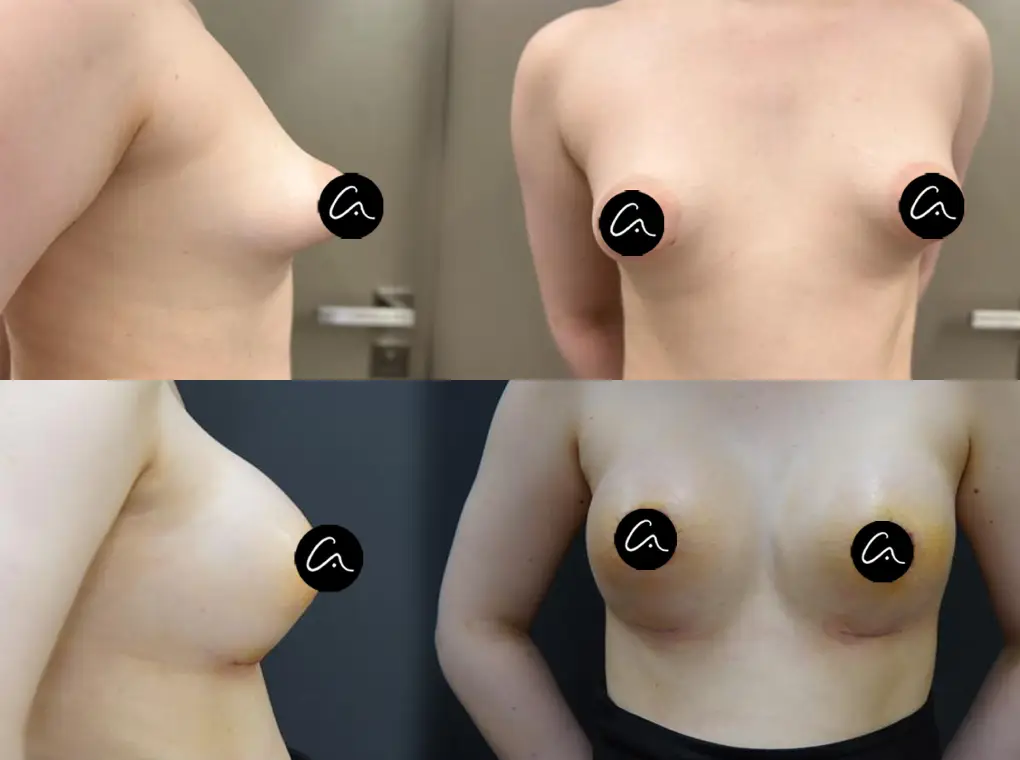
To understand how to correct a tuberous breast, we must first look at the unique anatomy that defines it. Unlike typical breast development, where tissue expands evenly across the chest wall, tuberous breast development is restricted by a tight, fibrous ring of tissue at the base of the breast.
This restriction results in three distinct anatomical characteristics:
One of the most critical pieces of medical candor we share with our patients is that standard breast augmentation will not fix a tuberous breast. In fact, simply placing a silicone implant into a constricted breast without addressing the underlying tissue can make the problem much worse.
When a standard implant is inserted beneath a tight, fibrous ring, the implant cannot expand naturally. Instead, it either pushes the existing tissue further forward, creating an artificial look known as the Snoopy deformity, or the implant sits awkwardly below the constricted breast, resulting in a double bubble appearance.
To achieve a beautiful, unoperated aesthetic, a surgeon must move beyond cookie cutter templates. We must meticulously release the internal structural bands before we can shape the external form.
Correcting a tuberous breast requires a highly tailored combination of techniques designed to expand the base, restore the lower pole, and reduce the puffiness of the areola. Dr. Celal approaches this through a comprehensive, holistic plan that may include several synchronized steps:
Before placing an implant, the dense ring of fibrous tissue must be carefully released from the inside. This internal scoring allows the constricted breast tissue to unfold and expand across the chest wall. Once the base is opened, a carefully selected implant is placed to fill out the deficient lower pole, creating a soft, natural teardrop slope.
To address the herniation and puffiness, a specialized technique is used to reshape the areola. By removing a small, doughnut shaped ring of excess skin around the border, we can reduce the size of the enlarged areola and flatten the herniated tissue, bringing the nipple into perfect proportion with the rest of the breast.
In cases where there is a significant amount of skin laxity, dropping, or asymmetry, a breast lift is integrated into the procedure. Depending on the patient's unique physical architecture, this may involve a tailored L scar or T scar incision. This allows us to gather and elevate the native tissue, creating a stable, long lasting foundation that supports the new volume beautifully.
The ultimate goal of tuberous breast surgery is to transition the body away from a state of restriction and into a state of natural harmony. Under the philosophy of the unoperated aesthetic, success is not measured by how large the breasts become, but by how seamlessly they integrate with your natural frame.
Through precise structural adjustments, a shape that once caused years of self consciousness is transformed into a natural, balanced contour. The physical architecture is stabilized, the emotional burden is lifted, and you are finally left with a silhouette that feels entirely, beautifully your own.
Ready to discover your options?
Every tuberous breast case is completely unique and requires a highly customized surgical roadmap. If you are ready to learn how a tailored combined approach can restore balance to your profile, we are here to support you. We offer a free online consultation designed according to your personal needs and goals. Reach out to our team today to schedule your virtual structural assessment.
No, standard breast augmentation alone will not fix a tuberous breast. Simply placing an implant without addressing the tight, fibrous ring of tissue can actually worsen the appearance, leading to unnatural results like a double bubble effect or Snoopy deformity. The internal constrictions must be released first.
Tuberous breasts are a genetic and developmental condition. During puberty, a tight ring of fibrous tissue forms at the base of the breast, restricting normal expansion and causing the tissue to push forward through the areola, resulting in a narrow base and puffy appearance.
It depends on your unique anatomy. In cases where there is significant skin laxity, dropping, or noticeable asymmetry, a structural mastopexy, or breast lift, is integrated into the procedure to create a stable, long lasting foundation for the new volume.
Yes. Tuberous breast correction often includes an areolar revision via periareolar mastopexy. This specialized technique removes excess skin around the border, reducing the size of the enlarged areola and flattening any herniated tissue to bring the nipple into perfect proportion.
Every case is completely unique. We offer a free online consultation tailored to your personal needs and aesthetic goals. Reach out to our team in Istanbul to schedule a virtual structural assessment with Dr. Celal to determine the best customized surgical roadmap for you.

Dr. Celal Alioğlu is a European board-certified specialist in plastic, reconstructive, and aesthetic surgery. Based in Istanbul, he combines international surgical standards with a refined, patient-centered approach for both local and international patients.
With memberships in leading global medical organizations and a commitment to continuous professional development, Dr. Alioğlu provides safe, ethical, and personalized surgical care.
More About Dr. Celal +